I’ve bagged Lenins by the dozen. And even a couple of Stalins.
But a Brezhnev? In the wild? Now there’s a real rarity. But there he was, striding casually down the street in downtown Novorossiysk. So I nabbed him.
This isn’t the doddering, geriatric Brezhnev of the 1980s. This is the rising apparatchik, posed with a hint of rebellious informality, a loosened tie and a jacket casually slung over one shoulder. Not the wooden politburo veteran, but the younger man-of-the-people getting ready to grab power. The Brezhnev who recklessly sped in (and sometimes crashed in) high-end foreign cars.
The most amazing thing about the statue is that it was erected in 2004, long after the fall of the USSR, paid for by local public contributions.
Why does Novorossiysk love Leonid Brezhnev so? Well, Brezhnev liked to emphasize his heroic war record, centered on the Northern Caucasus, including Novorossiysk. As Brezhnev rose in power, so did his remembered heroism and so did the remembered importance of (among others) the heroic battle of Novorossiysk. And so in 1973 Novorossiysk was awarded the prestigious Soviet title of “Hero City”, one of only a dozen such. And the citizens are no doubt grateful for this favor.
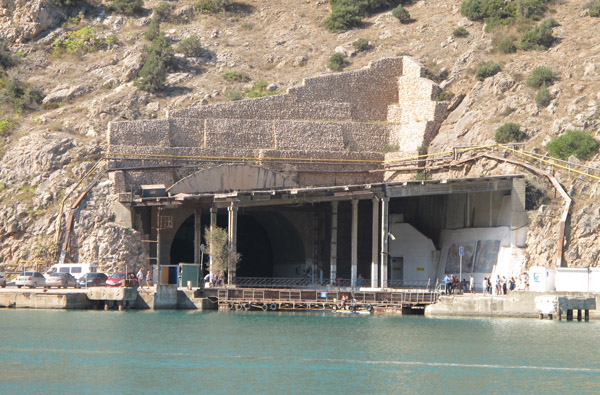
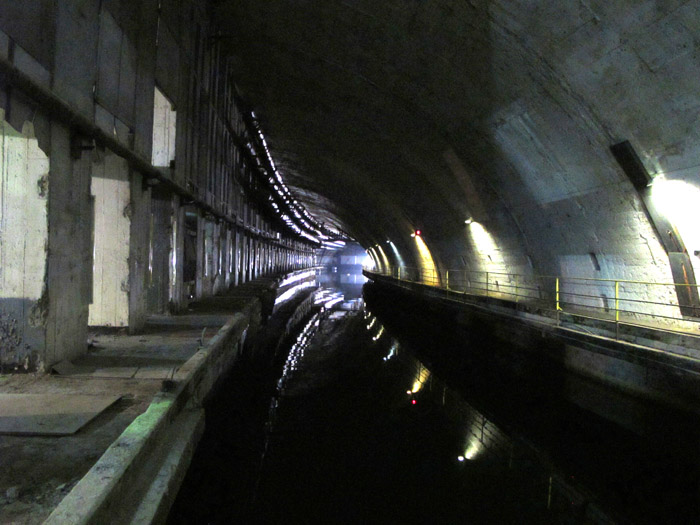
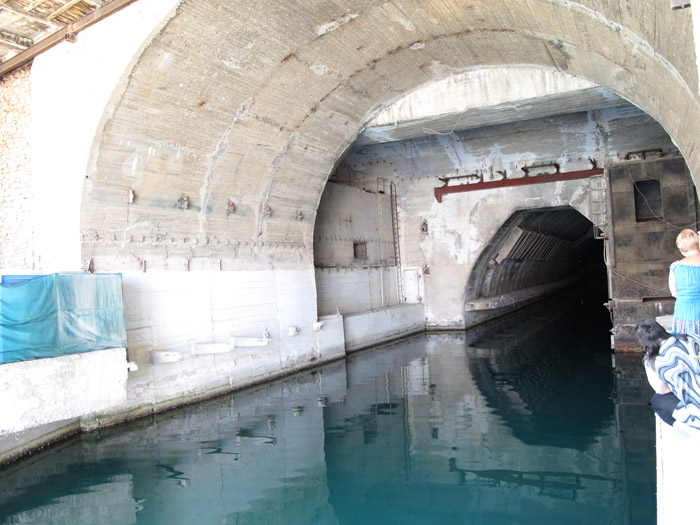
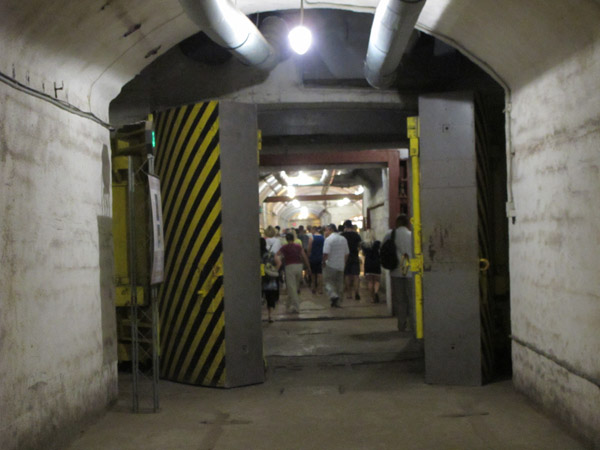
In Balaklava, Ukraine, I visited one of the USSR’s super-secret bases, “Facility 825”. This is a giant semi-submerged underground lair, where submarines could enter, be refueled or repaired, and be entirely invisible from the air.
Oh yes, and it was designed to survive a 100 kiloton direct hit.
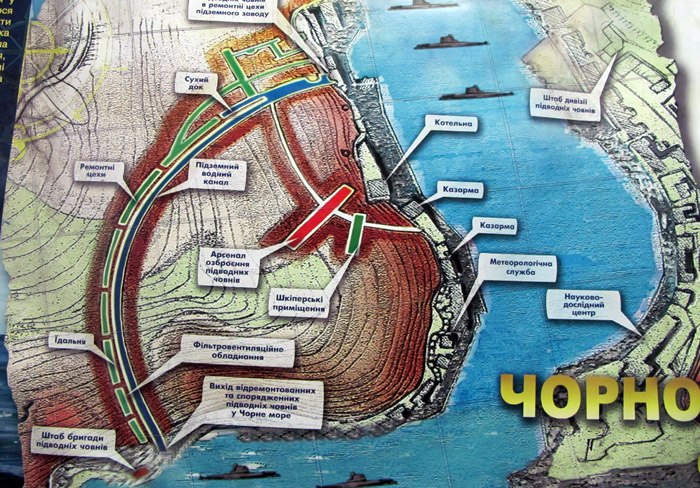
The base seems to have been conceived in the early 1950s. It was constructed by the teams who had built the Moscow and Kharkiv metro systems, so it isn’t too surprising it takes the form of a giant tunnel, with a concealed entrance in the Balaklava harbor and an exit into the Black sea. The tunnel is wide enough to allow subs to be docked at one side for maintenance, while others slid past in the main channel.
The base is also chock-full other tunnels, for the supporting humans and for the various arsenals.
Facility 825 was super-secret in its day. The entrance is designed to be invisible from the air. They were initially worried about spy planes, but of course this also worked well against satellites. The Soviets apparently hoped to keep even the existence of the base entirely secret, using various ploys to conceal the construction work.
But where are the nuclear wessels?
It was decommissioned in the early 1990s, but even today it’s hard to find reliable data on what was actually based there. It is generally cited as a “nuclear base”. But as far as I can figure, it was only used for Whiskey and Romeo diesel powered subs (the tunnel was probably too narrow for the later nuclear subs). There were probably nuclear warheads, but even that is a little unclear.
It’s all a wonderful relic from the Cold War. It’s rather sad to see it turned into a rather desultory museum. Where are the international super-villains when you need them? Why aren’t aspiring megalomaniacs bidding frantically to “borrow” it for “historic renovation”? Alas, we live in banal times.
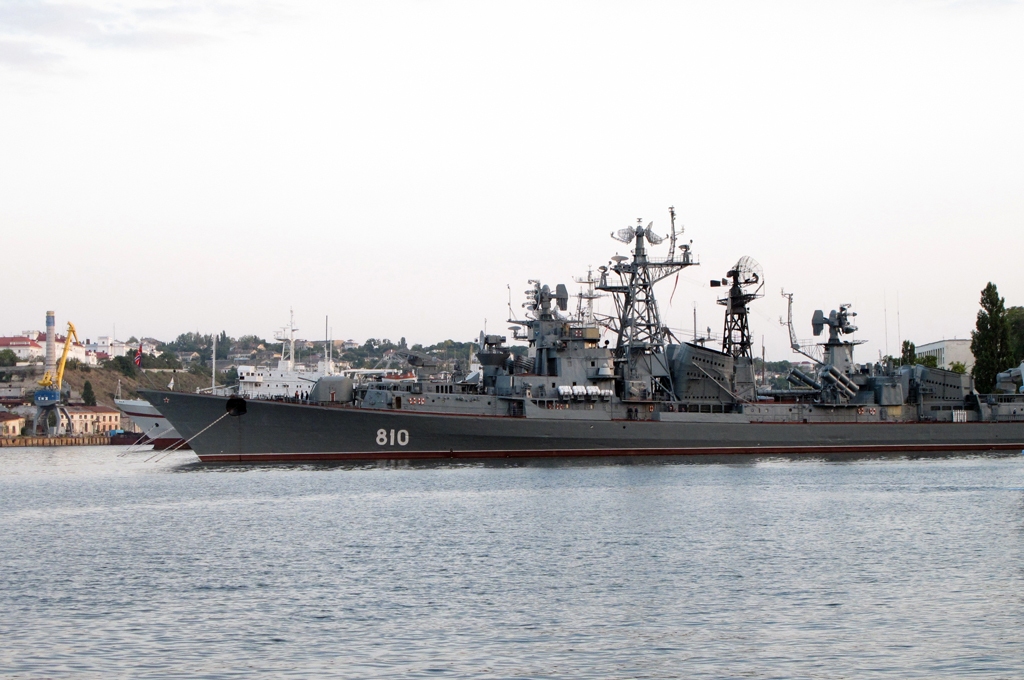
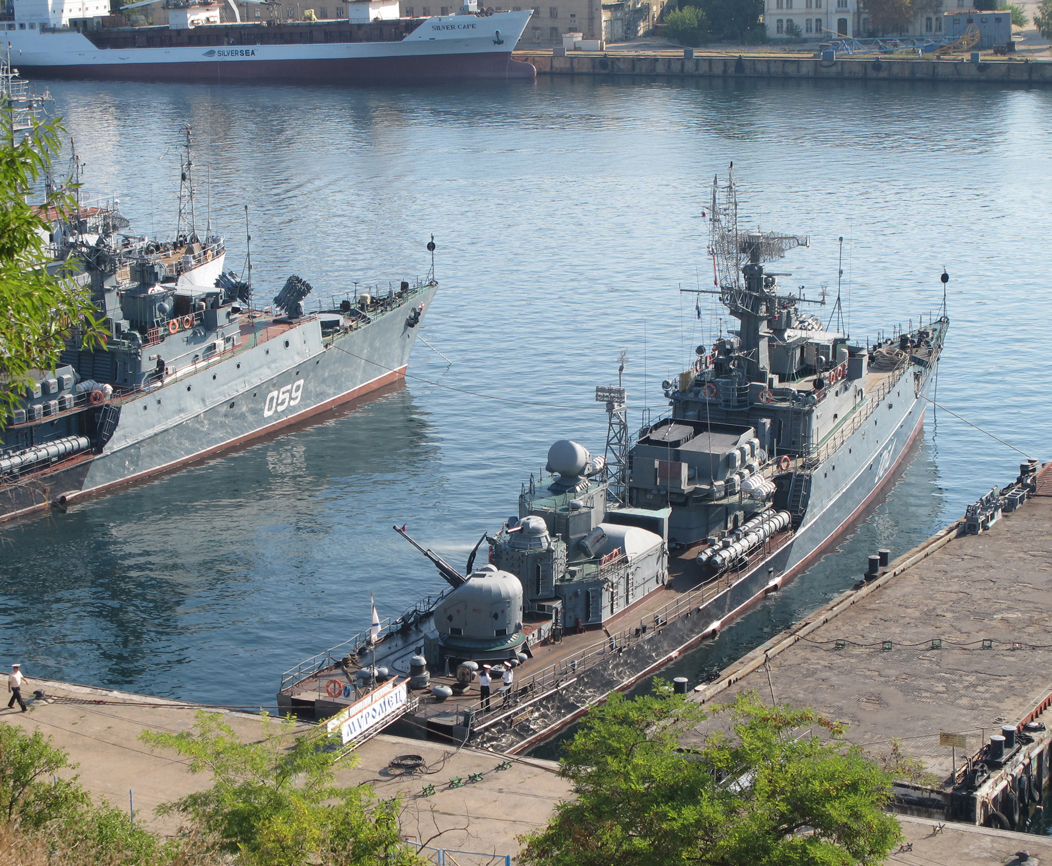
The city was formerly host to the Soviet Black Sea Fleet. After 1991, the fleet was partitioned between Ukraine and Russia and both halves are still based at Sevastopol, although most of the warships I spotted had Russian ensigns.
Like Vladivostok, Sevastopol was a closed city during the Soviet era, so it feels strange to be able to wander freely and admire the once guarded fleet. I kept expecting the heavy hand of Soviet Power to suddenly grab me by the shoulder.
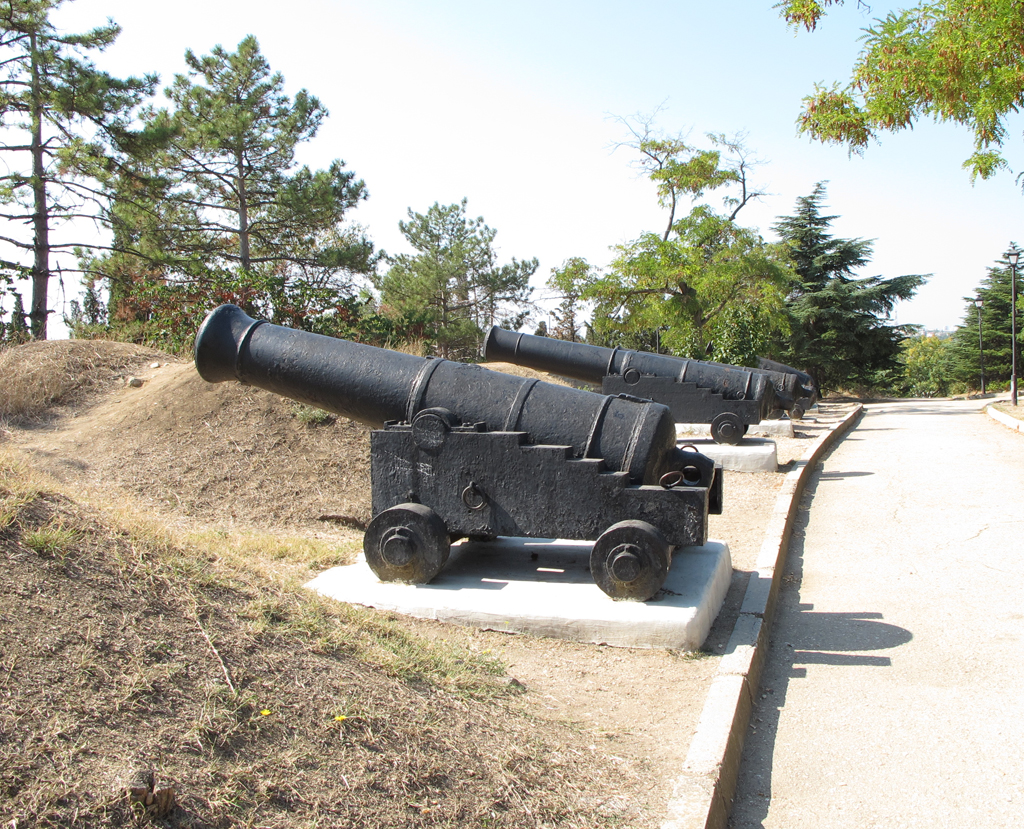
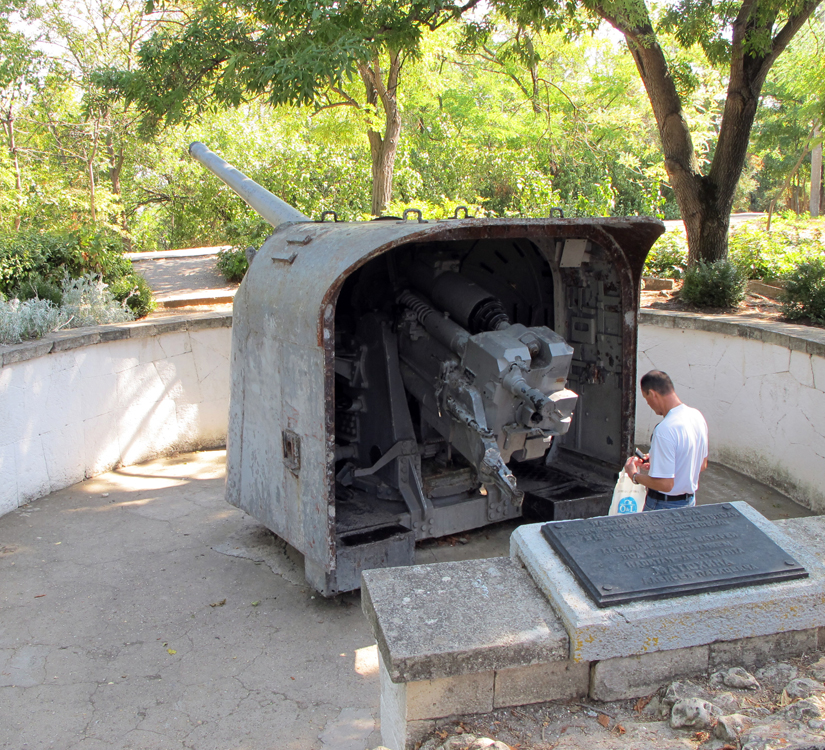
The city also hosts an eclectic mix of memorials from the Crimean War, WWII and Soviet periods.
Crimean War Cannon, Malakhov Mound.WWII Artillery, Malakhov Mound.
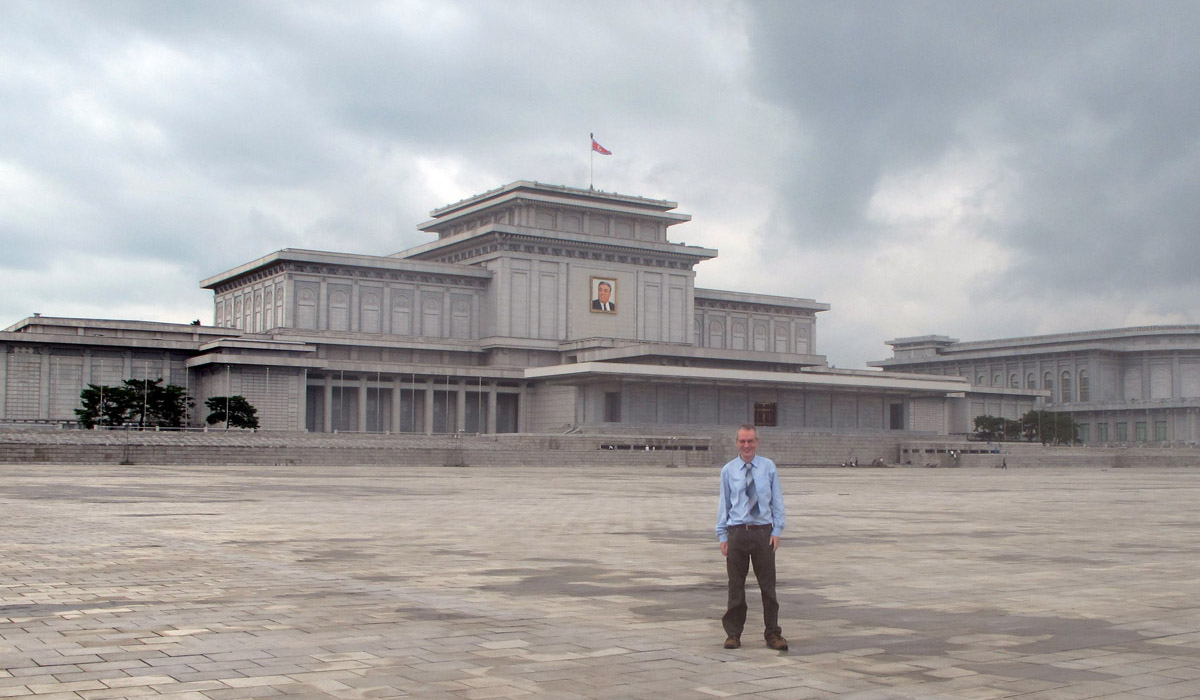
I’ve been through the Lenin Mausoleum and the Mao Mausoleum. The Kim Il Sung Mausoleum is much, much, more intense than either. Definitely no loitering, chattering, or smirking.
We were strongly encouraged by our guides to dress in our best clothes and to wear shirts and ties for our visit.
The Mausoleum is a large sprawling building, formerly the Presidential Palace. Visitors are carefully screened before entering. Cameras and bags must be left behind. And of course we had surrendered our cells phones on entering North Korea.
We were conveyed inwards through marble corridors on long moving walkways and escalators. As foreigners, we were given priority over patiently queuing North Koreans. The general mood was one of hushed respectful silence, and we tried to blend into that. Rumor has it that Chinese tour groups are no longer allowed to visit the Mausoleum, supposedly because they tended to be too noisy and thus “disrespectful”.
As we neared the inner sanctum we passed through air blowers to blow away any dust we might bring with us.
We passed through the “Hall of Lamentations” where by holding little MP3 players to our ears we heard a description of how the North Koreans had lamented the Great Leader’s passing. (The MP3 players also kept us quiet and attentive.)
Then finally we entered the sanctuary and paraded around the preserved figure. As we had been instructed we bowed carefully at the sides and base. (But not at the head. Not at the head!) Kim Il Sung looks much less waxy and distinctly less vampiric than Lenin, but I’m afraid he does look rather Brezhnev-esq.
We exited into a room full of the Great Leader’s honors and awards. We all relaxed slightly and admired the lengthy collection, including two Orders of Lenin, a standard Stalin WWII victory medal, and honors from most of the former USSR Republics and many other nations. The only US honor was a degree certificate from the little known Kensington University of California. Some of the honors were posthumous, even as recent as 2007, presumably to recognize Kim Il Sung’s continuing role as the DPRK’s “Eternal President”.
Breathing more easily, we now headed out. We were discreetly studying the inward bound North Koreans and they were similarly studying us. Sometimes covertly, sometimes fairly openly, occasionally defiantly staring past us. Mostly they seemed simply curious, occasionally friendly, in a very few cases hostile. Some of these visitors might be making a once-in-a-lifetime visit to Pyongyang to see the Great Leader, so they were naturally curious at the unexpected bonus of exotic foreigners.
I wonder what they made of us? I do rather fear that the regime makes use of visiting foreigners as further proof of the Leader’s greatness. See, even foreigners come from far away, neatly dressed, to bow at the Great Leader. Hmm. That isn’t quite what I had in mind.
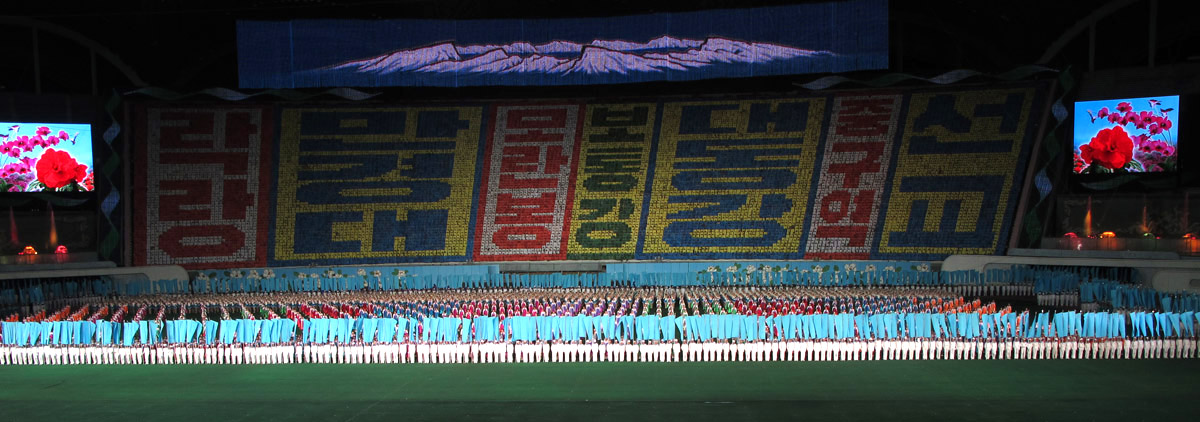
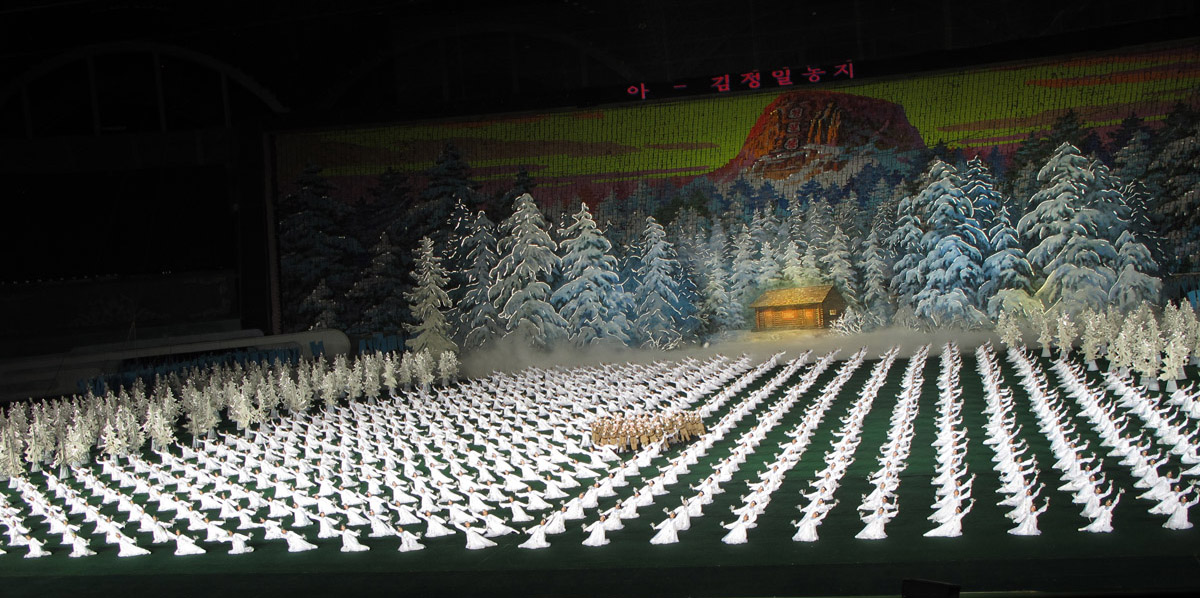
I attended the Mass Games in Pyongyang. They were a bizarre, wonderful and very intense experience. (More photos here.)
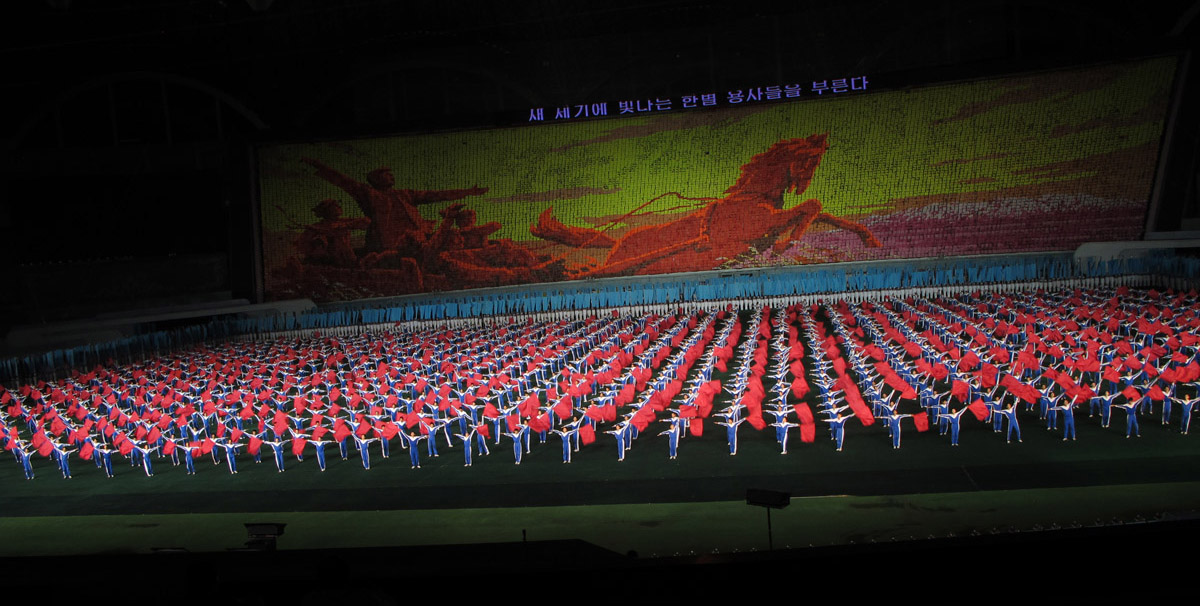
The current version of the games, the “Arirang”, tells the history of North Korea through a giant series of dance and gymnastic sequences. There are reportedly up to 100,000 participants, although only a few hundreds or thousands appear in any one scene. Fifteen thousand children with giant flipcard books provide a continually changing background display. The games take place in a giant custom-built stadium. I had coughed up the 150 Euros (ouch) for a first class seat in the central viewing area.
The many scenes include the historic birth of Korea; the struggle against the Japanese; a celebration of the birth of Kim Jong Il (yes, really!); the happy prosperity of the nation (!!); a joyful vision of the future reunification of Korea; and a paean to Chinese-Korean friendship.
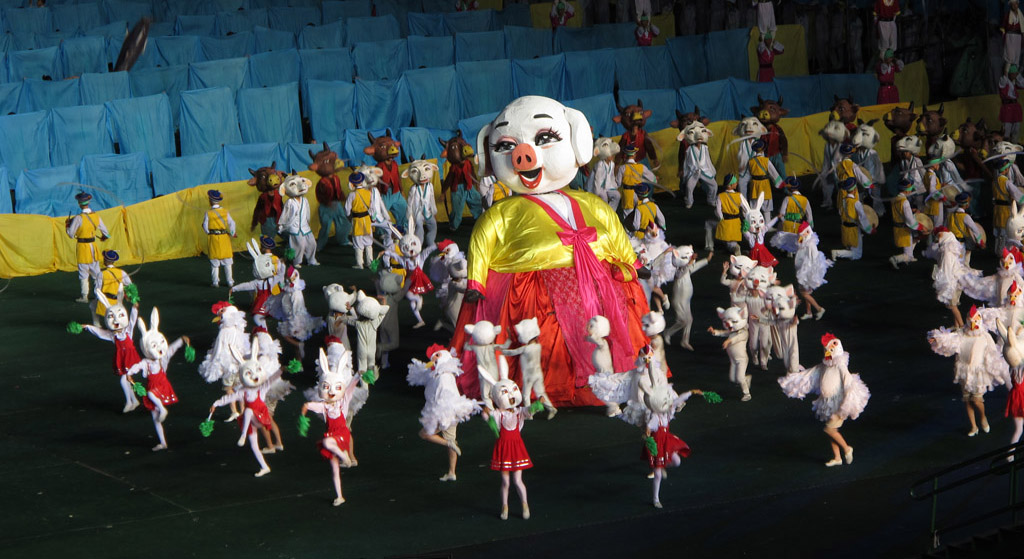
The tone is not particularly militaristic. It is often light and in a few places even playful, with friendly pandas doing pratfalls, and comical chickens and pigs dancing to celebrate prosperity. There is no overt hostility to either South Korea or the US. But the background music is stirring, the massed coordination is often daunting, and the general mood is intense and fervent.
Photographs and videos can’t really convey the intensity of seeing the live performance. As soon as you step in, you are swept up in the forceful warm-up music. The staging and presentation are extremely skilful: you initially see a vast wall of banners and then through them advancing what seems like an infinite army of performers. The stadium is too wide to be easily taken in in one glance, I had to keep my eye roving to see the full picture. The scene transitions are often cleverly dramatic: as one scene winds down and the actors start to exit, we are allowed to glimpse a new army of performers massing in the back, then the lights are dimmed, leaving just enough light to see a shadowy horde surging forward onto the arena floor.
The dancing and gymnastics are well choreographed. If they were performed by a few score people, they would be only moderately amusing. But when they are performed on the Mass Games scale they become a very different thing. Some of the scenes are elegant ballet like performances, other are mass marching or banner waving, others are seemingly informal, such as the invasion of the happy farm animals.
Most of the performers are young adults. A couple of scenes involved hordes of 8-10 year olds.
The performances are skilful, but on this scale a few flubs are probably inevitable. I noticed a couple of the younger kids accidentally collide and go sprawling. But part of their training seems to be in quick recovery, and amidst the mass of performers you have to watch carefully to spot glitches and the overall experience continues undisturbed. There was heavy rain in mid-performance. We spectators were safely under cover, but the performers got pretty wet and had to cope with shallow puddles.
I liked the experience enough that I coughed up more Euros the next day for a second look. It was actually better the second time, partly because I had a better sense of what the script was trying to say and partly because I could anticipate the timing and what to watch for. Also, since it was dry, they were able to include the concluding grand firework display this time.
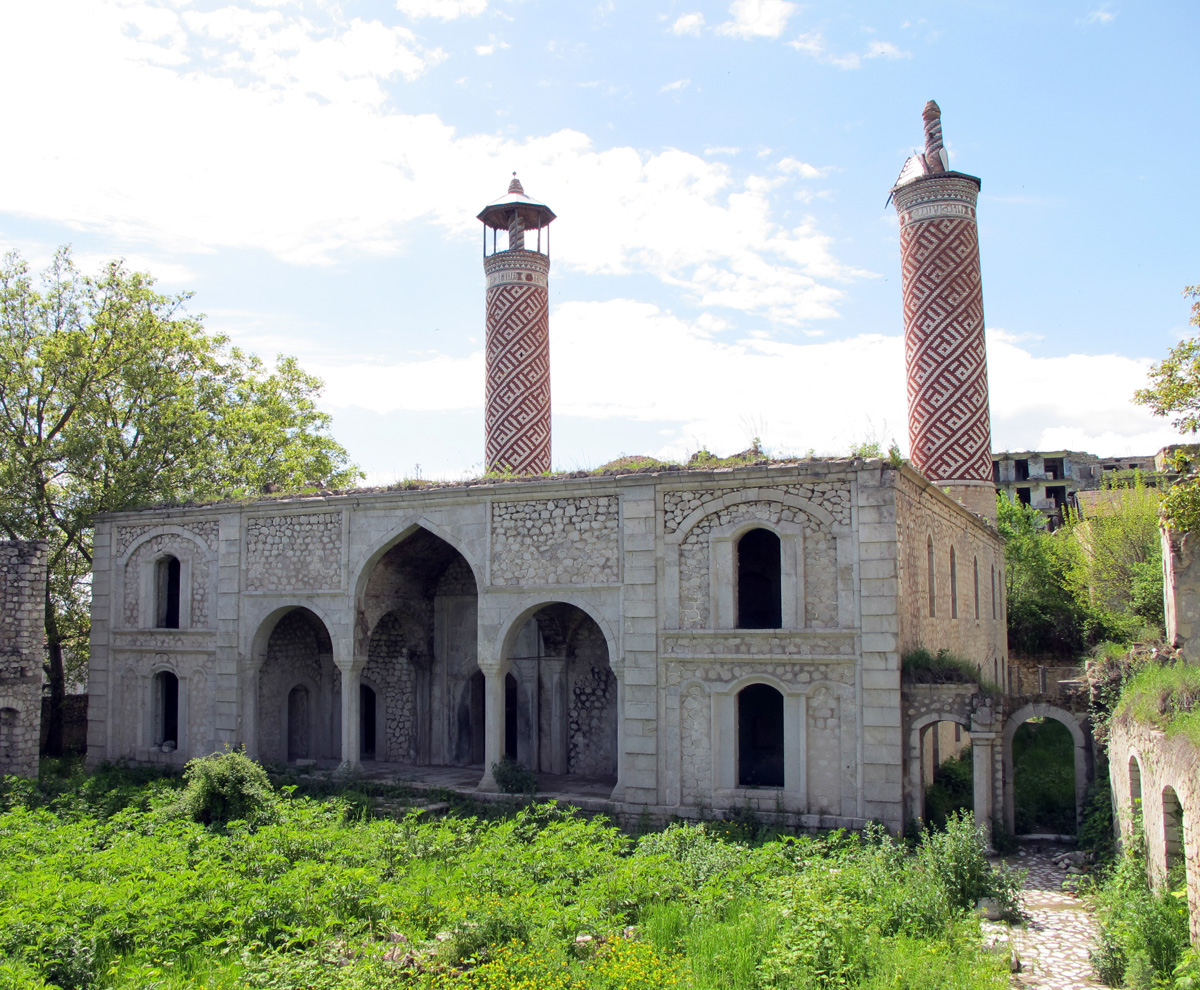
I took a marshrutka out from Stepanakert to the old scenic town of Shushi.
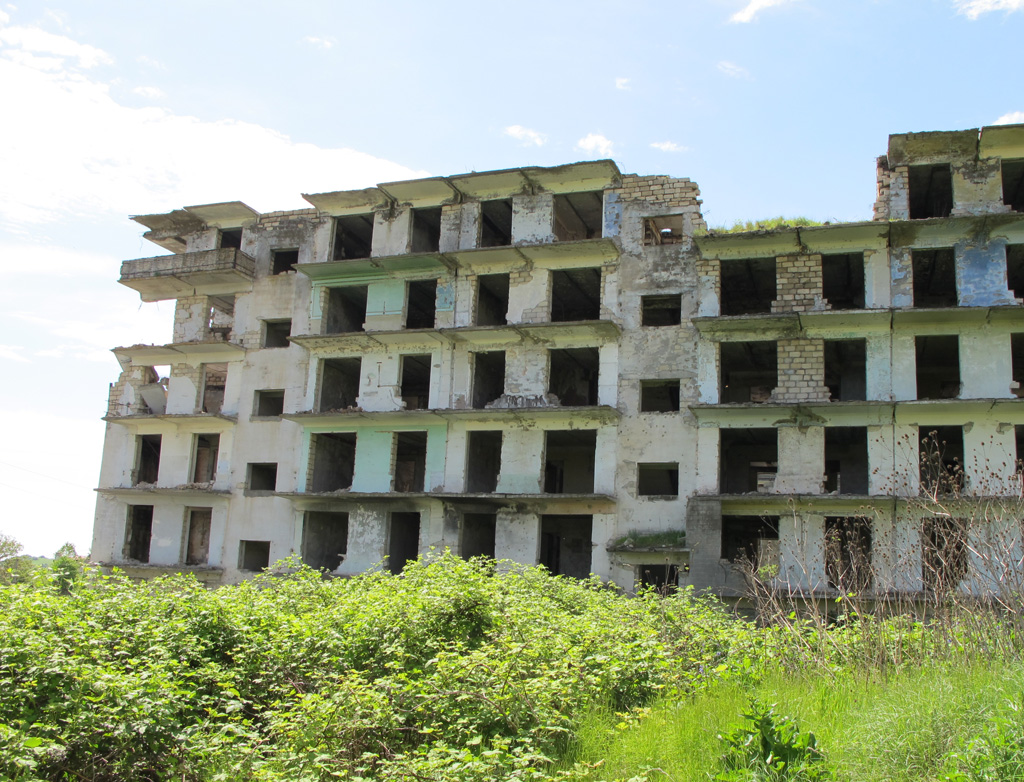
Shushi was on the front-line of the 1990’s Nagorno-Karabakh war and suffered heavy damage. It was an Azerbaijan stronghold, opposing Armenian-held Stepanakert. Over the course of the war most of the population fled, and the town still has many abandoned buildings.
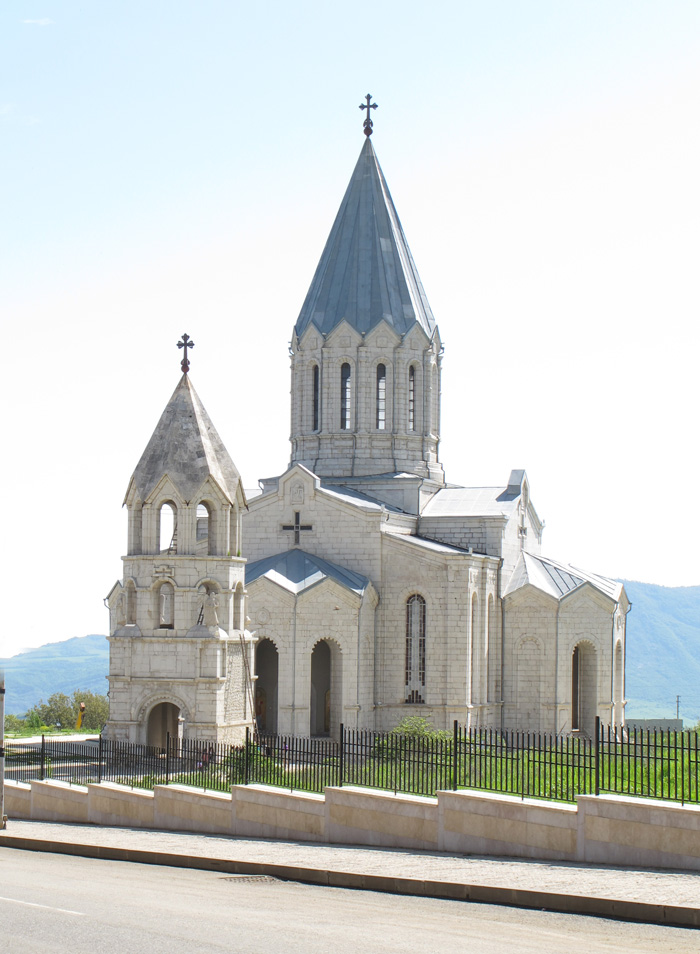
Ghazanchetsots
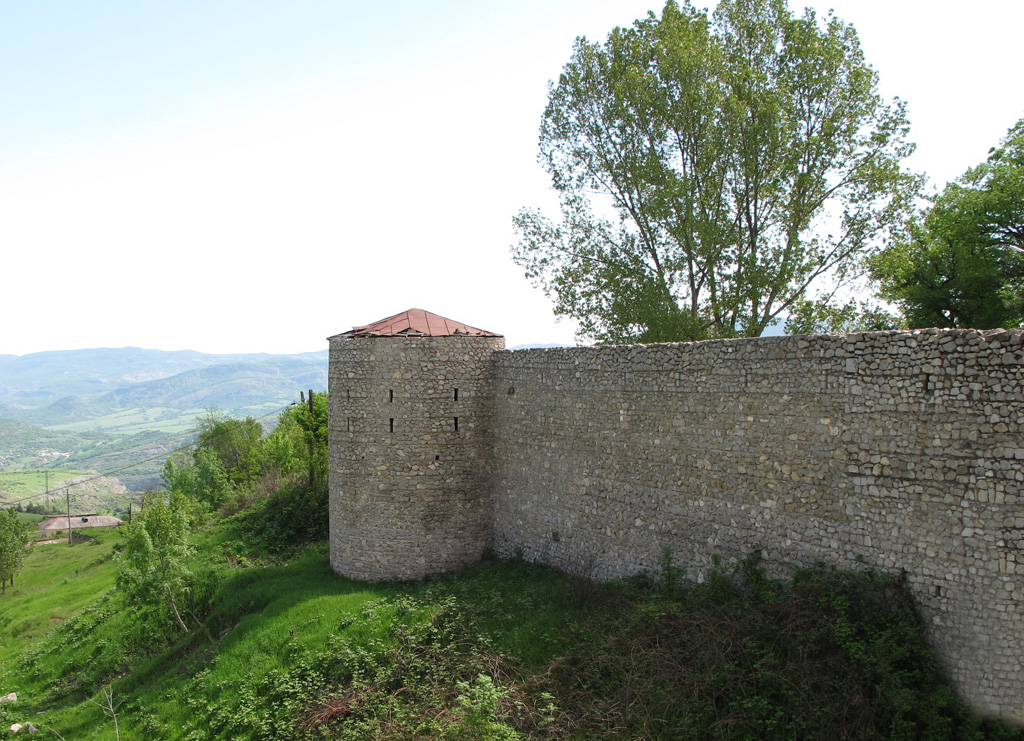
I started at the Ghazanchetsots Armenian Orthodox cathedral, which is partly restored but mostly new built and looks very spiffy. The interior has some well-executed modern murals in a classic icon style. Then I strolled out to the old city walls. These also appear to have been fairly aggressively restored after the war: most of the stonework looks fairly new.
After some searching, I found my way to the remains of the old mosque. In an elegant theological touch, it’s two minaret towers have the Arabic letters for “Allah” repeated in white-on-red stripes ascending up towards heaven. The mosque interior is gutted and the courtyard is overgrown with weeds.
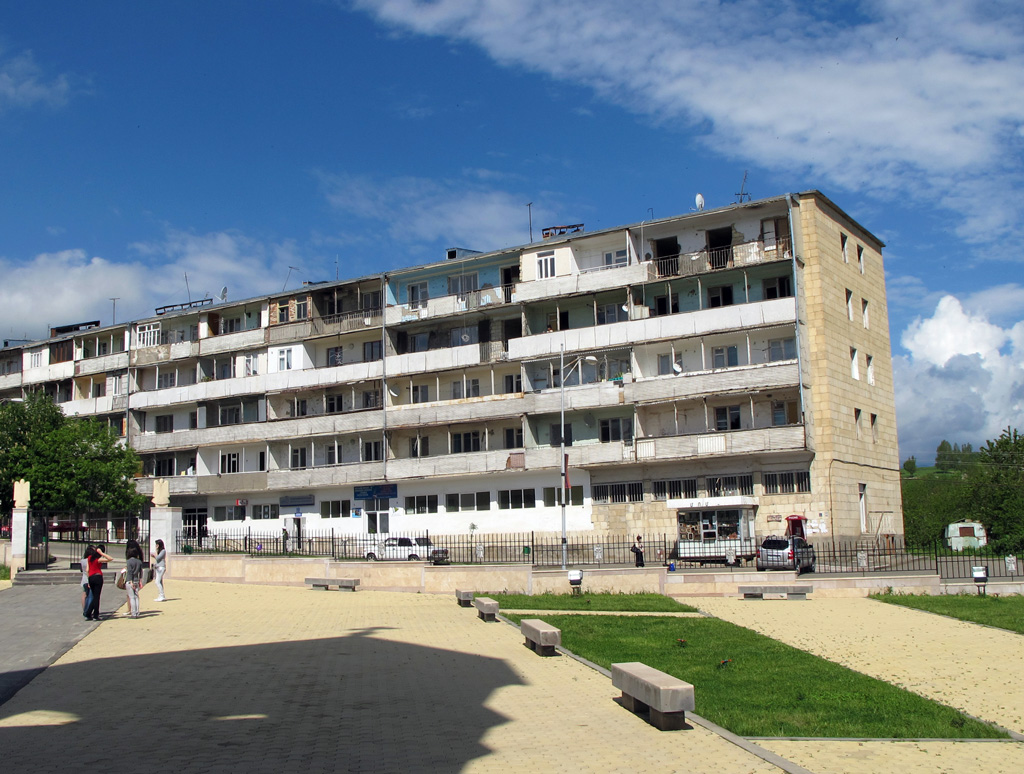
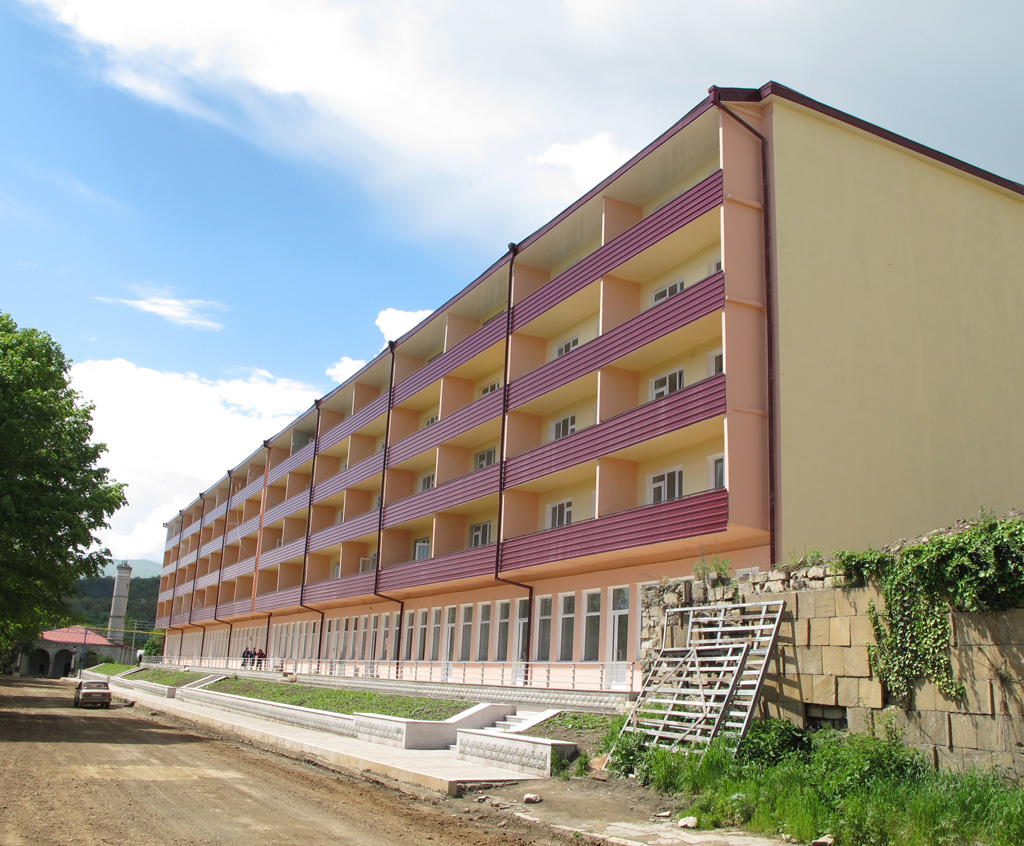
The center of town contains many decrepit old Soviet-style apartment blocks. But there is also some amount of new construction and renovation going on. Further out there are many derelict and abandoned buildings, some mere shells.
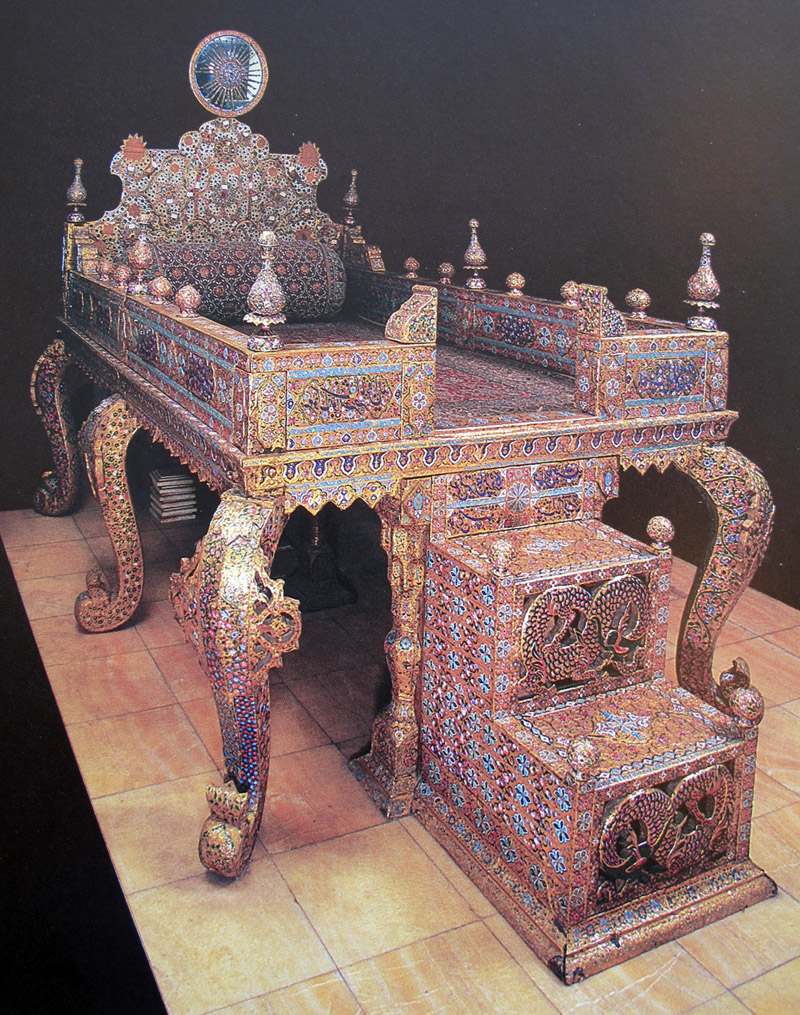
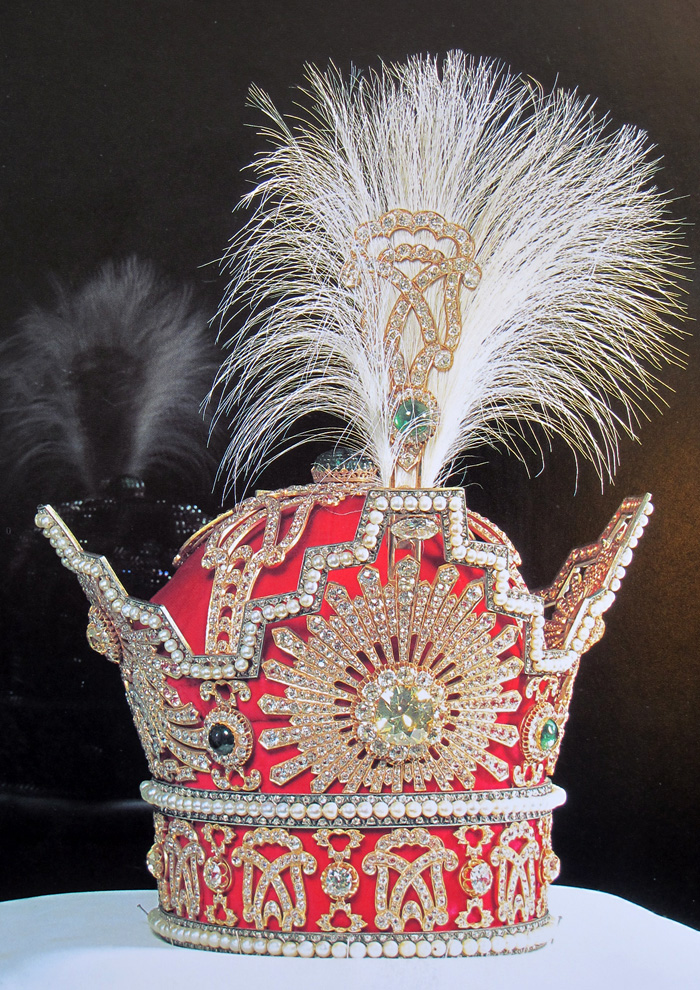
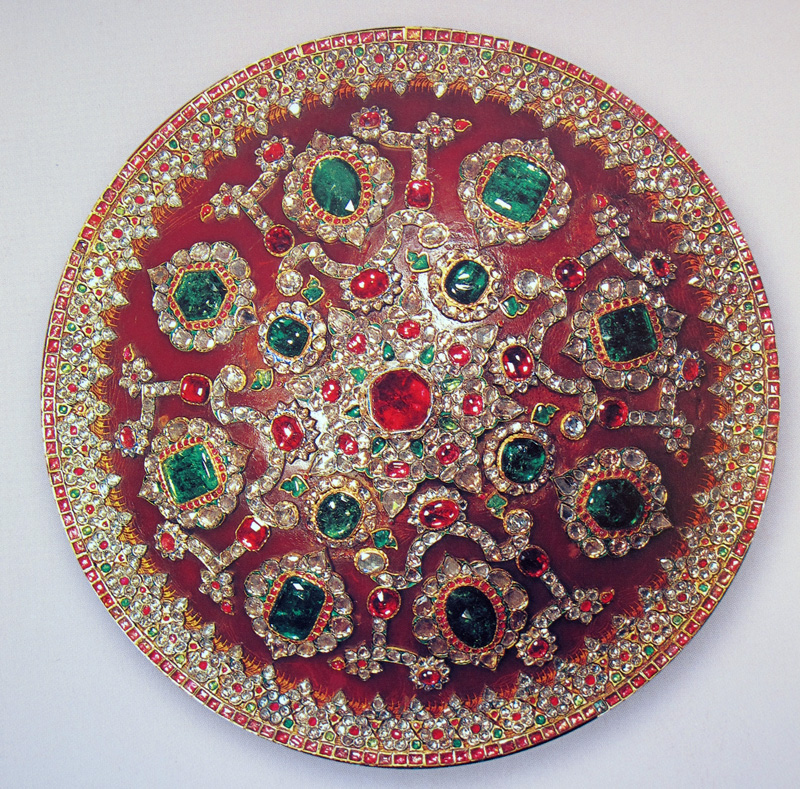
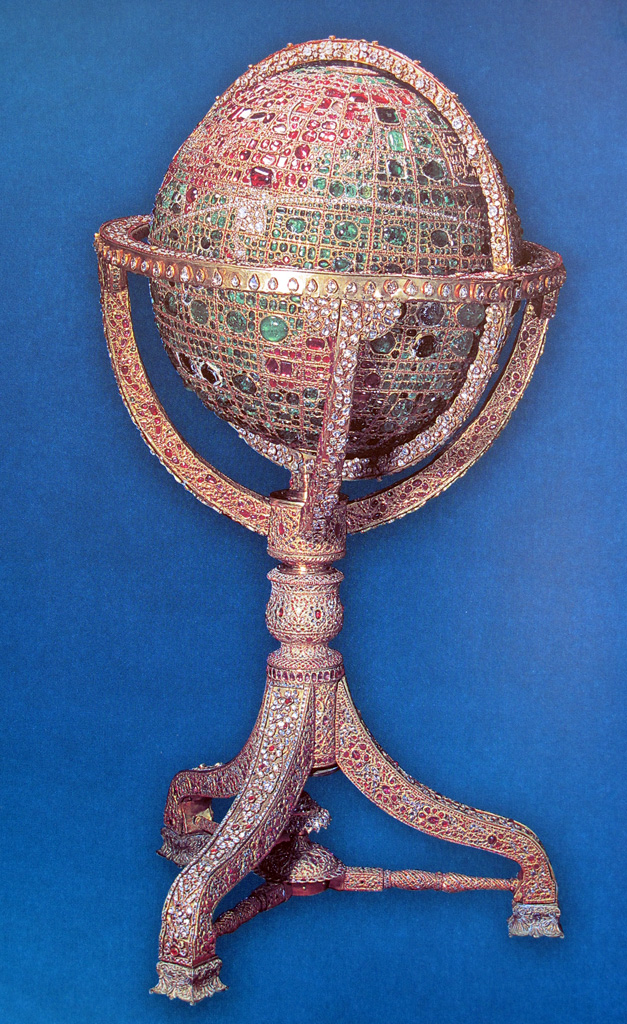
The Peacock ThroneReza Khan CrownJewelled BucklerJewelled Globe
The Tehran National Jewels Museum is truly over-the-top, with a staggering collection of gem encrusted artifacts.
I had missed this when I was in Tehran in 2008, so I made sure to catch it this time.
The collection is in 37 large display cases, full of many lavishly decorated items. There are bright crowns, covered in pearls, a red and green encrusted globe, endless small artifacts covered with small red, green, and white stones.
OK, my first reaction on seeing all of this was to assume it couldn’t all be real. There is just too much stuff. And too many bright colors. It looks like costume jewelry. It can’t possibly all be real. Can it?
Then I stopped, and thought, and read the guide book. This is the accumulated collection of the Shahs of Persia. For several centuries they were the wealthiest potentates of the region, avidly buying up the best gems for their treasury. And that collection was never broken up. The 19th c. shahs added to it, including many large South African diamonds. The 20th c. Pahlavi shahs added further jewels and the collection survived the 1979 revolution intact. So, yes, the Museum is hosting the centuries old accumulated collection of very wealthy rulers. So, gulp, it is probably mostly real. (Even the best museums have the occasional imposter.)
Some of the more striking pieces include
the Reza Khan crown (with 3380 diamonds and 368 matched pearls)
the Darya-i-Nur “Sea of Light” 182 carat pink diamond
a large globe with the land marked with rubies and the seas with emeralds
a sword scabard entirely covered in 1869 rose-cut diamonds
a circular shield decorated with giant rubies and emeralds
just outside the vault proper is a display room holding the jewel encrusted Peacock Throne
Oh my.
Some items do look rather gaudy: I guess when you use large emeralds and rubies, it is hard to look restrained.
The Museum is not sign posted. It is in a bank vault underneath the Melli Bank on Ferdossi Street, but to reach the Museum you need to enter via the the Central Bank building just to the North. They store your bag (and camera), run you through a metal detector and then send you South across a courtyard to the vault.
The Museum hours are 2:00-4:30 pm on Saturday to Tuesday. It is definitely worth trying to visit if you are in Tehran.